
How Claude Code rate limits actually work
Two overlapping windows, one weekly ceiling, and the habits that burn your quota fastest.
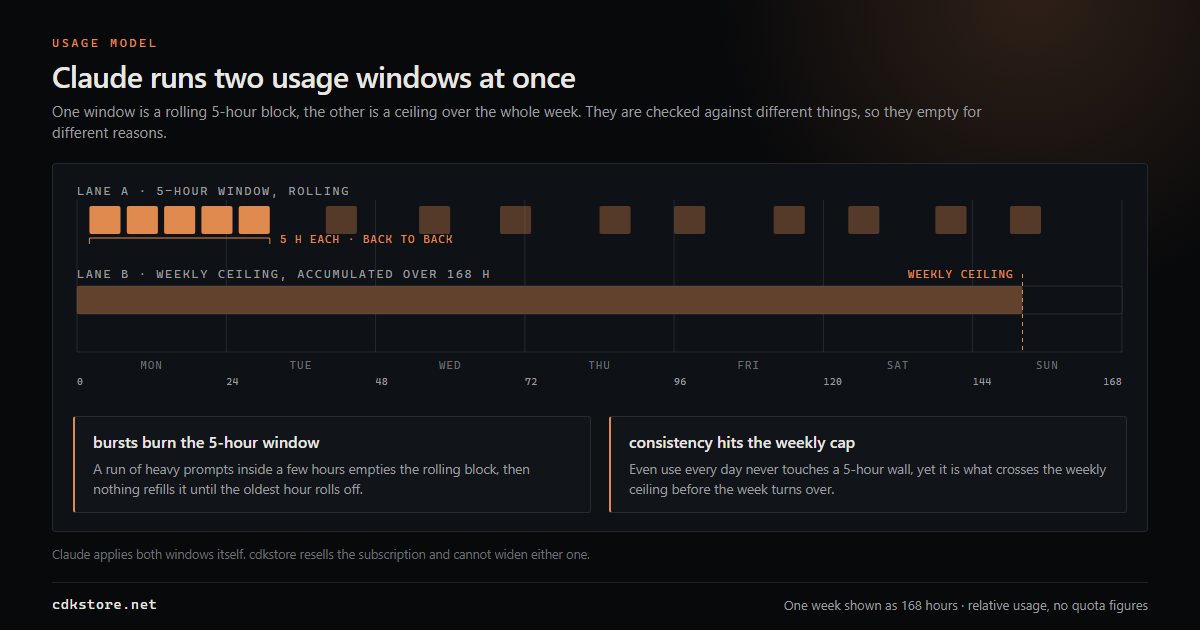
Almost every "Claude is unusable today" complaint is a rate limit, not an outage. The limits are not a single counter — they are two windows running at once, and misunderstanding either one makes the plan feel broken.
The short window
The first limit is a rolling block of roughly five hours. Usage accumulates inside it, and when you cross the threshold you wait for the block to move, not for a reset timer you can see. This is the limit people hit on a heavy afternoon: the work is going fine, then everything stops for an hour.
Practical consequence: the block rewards pacing. Twenty short requests spread over five hours cost far less than the same twenty fired in one long agent run, because the second one stacks context on every turn.
The weekly ceiling
The second limit is a weekly cap. It exists to stop the pattern where somebody avoids the short window by staying just under it all day, every day. You will not notice it for a week and then lose most of a day to it. If your usage is steady rather than bursty, the weekly cap is the one that actually governs your plan.
What burns quota fastest
- Long agent loops on large repositories. Every iteration re-reads context. A twenty-step loop is not twenty times one step — it is closer to two hundred.
- Parallel sessions. Three sessions in one repository triple the reads and can invalidate each other's cache.
- Huge pasted files. Pasting an entire log or a three-thousand-line file once is often cheaper than asking the agent to read it repeatedly — but pasting it into every new session is worse than either.
- Restarting sessions instead of continuing. A fresh session re-establishes context from scratch. If the previous session was healthy, continuing is usually cheaper.
How to make a smaller plan behave like a bigger one
Scope the agent before you start it: one directory, one goal, one stop condition. Ask for a plan first and approve it, so the expensive exploration happens once. Keep a scratch file with the decisions made so far, so a new session does not rediscover them. And do the cheap edits by hand — not every change deserves an agent.
The moment you hit the wall
What to do in that first minute matters more than people think. Write down the task exactly where it stopped, including the file you were in and the command that failed, then switch to work that does not need the model at all: reading the diff you already have, running tests locally, refactoring by hand. Trying three more prompts while waiting usually just spends the part of the window that had recovered.
When to move up a tier
If you hit the short window more than once or twice a day, or lose real work to the weekly cap, the next tier is cheaper than the interruption. If you hit it once a week, it is not. Here Max 5x is 523 CNY (about 70 euro) and Max 20x is 1047 CNY (about 140 euro), each for one month, with the official equivalents 668 and 1336 CNY shown beside them on the Max 20x plan. The tier you are buying is headroom against the short window; nobody's weekly habit is saved by a multiplier alone.
For the reading next to this one: the weekly limit explained and what a long session costs.
Common questions
Is a rate limit the same as an outage?
No. An outage affects everyone; a limit is your account finishing the window it is allowed. The status of the service is separate from the state of your quota.
Do the two limits reset at the same time?
No. The short window is roughly a five-hour rolling block, and the weekly ceiling runs on its own period. Hitting one does not tell you anything about the other.
Does buying a higher tier fix bad habits?
No. Long agent loops and parallel sessions on one repository scale with the tier. Scope, plan-first and a scratch file are worth more than the multiplier.
Is continuing a session really cheaper than starting one?
Usually yes, because a new session has to rebuild context that is already loaded. If the current session is coherent, keep using it.
What do the tiers cost here?
Max 5x is 523 CNY, about 70 euro, and Max 20x is 1047 CNY, about 140 euro, each for one month, with the official equivalents shown next to them.
Guides
All guides →Claude Max 5x vs 20x: which tier you actually need
The difference is not quality — it is how many times you can hit the wall before lunch. A practical way to size your plan.
How to pay for Claude from mainland China (2026)
Four routes, ranked by how often they actually work — and the two that quietly cost you the account.